How to Choose the Right Laser Pointer for What You Actually Do With It
Laser pointers look like a simple category until you start shopping. There are red ones and green ones, low-power models and high-power models, ones designed for conference rooms and ones designed for pointing at stars. The specs in most listings — milliwatts, nanometers, beam divergence — aren’t explained in a way that helps you figure out which one fits your situation.
This guide cuts through that. The right laser pointer depends almost entirely on what you’re using it for, and once you know the use case, the choice becomes straightforward.
For Business Presentations and Conference Rooms
The most common use for a laser pointer is the most forgiving one. If you’re presenting in a conference room, classroom, or small auditorium — pointing at slides projected on a screen twenty to forty feet away — you don’t need high power. A 1mW to 5mW red or green laser is more than sufficient for this setting.
That said, green tends to be noticeably more visible than red at the same power level. The human eye is most sensitive to light in the green wavelength range (around 532nm), which means a 1mW green laser appears roughly five times brighter than a 1mW red one under the same conditions. In a well-lit conference room where the projected image isn’t particularly bright, that difference is real and practical — the green dot is easier for your audience to track without you having to hold it still for a long time.
For business use, other features matter as much as power: battery life, button feel, range of the wireless slide advance function if it’s built in, and whether the device is comfortable to hold during a ninety-minute presentation. A laser pointer you actively dislike holding will cause you to use it less, which is the opposite of the point.
For Teaching in Larger Spaces
Teachers present in spaces that vary enormously — a standard classroom, a large lecture hall, an auditorium with a screen two hundred feet away. The distance and ambient light level both affect how visible the dot is, and requirements scale up accordingly.
For lecture halls and large auditoriums, a green laser in the 5mW range is the standard recommendation. It’s bright enough to be clearly visible on a large projected screen at distance, legal in most jurisdictions at that power level, and not so powerful that accidental eye contact is a serious safety hazard — as long as basic precautions are followed (don’t point it at people, don’t hand it to students who aren’t going to use it carefully).
For standard classroom use, anything in the 1-5mW range works. The more important consideration in classrooms is often durability and how the device handles being dropped on a tile floor, which happens.
For Outdoor Use and Astronomy
Pointing at objects outdoors — stars, landmarks, geographic features during a hike or field lesson — is a fundamentally different use case from indoor presenting, and it requires a fundamentally different device.
The main difference is that outdoor pointing typically involves longer distances and open sky rather than a reflective screen. You’re not trying to make a dot visible on a surface; you’re trying to cast a visible beam that others can follow through the air. For this, you need substantially more power and almost certainly a green wavelength.
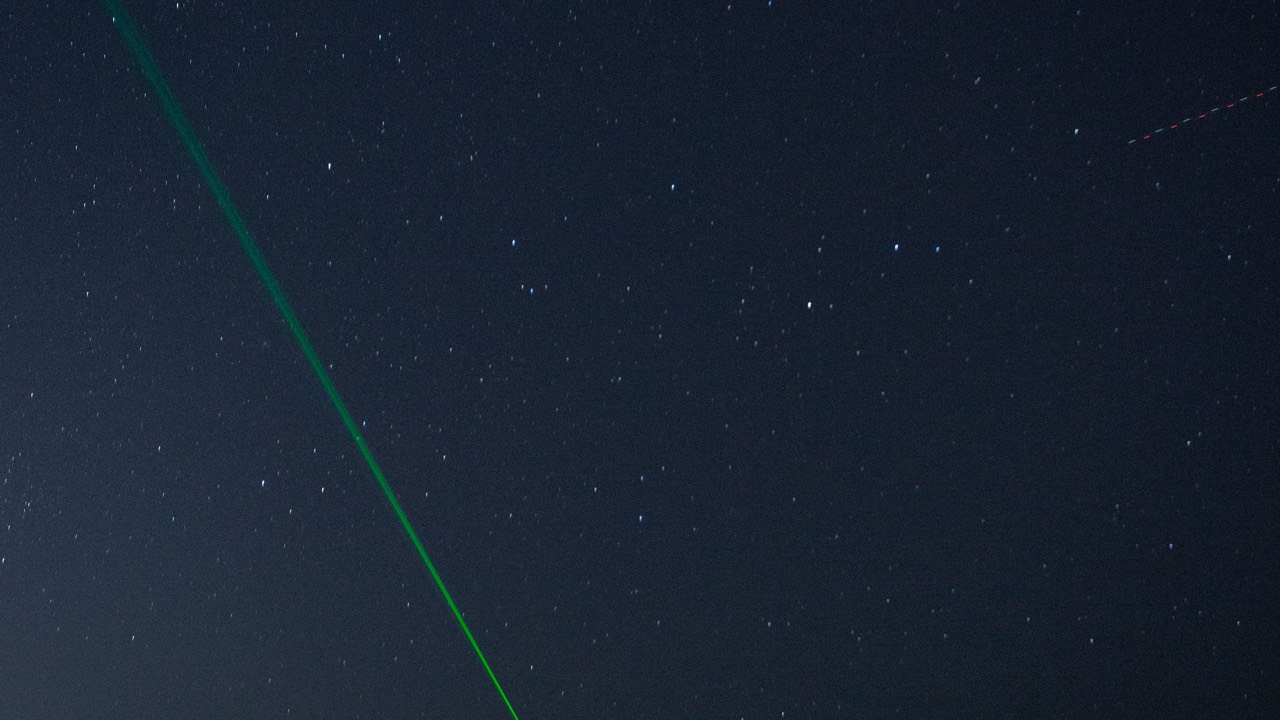
Green lasers are the standard for astronomy use because the beam itself is visible in the night air due to scattering — you can trace the line from the device to the star, which is the whole point of using one to show someone a celestial object. Red lasers at typical consumer power levels don’t produce a beam visible to the naked eye in the air; the dot is only visible when it hits a surface. For outdoor pointing and stargazing, green is not optional.
Power requirements for outdoor use start at around 50mW for casual use and go up from there depending on how far you need the beam to travel and how dark the sky is. Urban and suburban environments with significant light pollution may require higher power to produce a beam that’s clearly distinguishable from ambient light. Rural dark-sky locations are more forgiving.
It’s worth noting that high-power lasers (above 5mW in many jurisdictions) are subject to regulations that vary by country and use context. Understand what’s legal where you are before purchasing.
For Industrial, Technical, and Professional Applications
Surveyors, construction site managers, warehouse staff, and technical professionals use laser pointers in ways that consumer-grade devices weren’t designed for. Requirements here include durability, weather resistance, the ability to function reliably across temperature ranges, and often higher power for use in large industrial spaces with significant ambient light.
For these applications, the device category shifts from consumer laser pointer to professional laser tool, and the specifications matter in more detail: IP rating for dust and moisture resistance, operating temperature range, beam characteristics at the distances involved. Professional-grade devices in this category aren’t typically sold at the same price points as presentation pointers, and for good reason.
The Power Question: How Much Is Enough?
Most people buying a laser pointer for standard use overestimate how much power they need. For indoor presenting, 1-5mW is sufficient. For outdoor casual use, 50-100mW covers most situations. Power above that is for specialized applications.
The reason not to buy more power than you need is partly safety and partly legal. Higher-powered lasers can cause eye damage at ranges that might seem safe — the beam is invisible on the way to someone’s eye and the blink reflex isn’t fast enough to protect against brief accidental exposure at close range. Responsible use means knowing what your device can do.
For anyone navigating the range of options available — from basic presentation pointers to higher-power outdoor models — www.laserpointeur.fr covers the category across use cases, with product listings organized by application and power level to make the comparison easier.
What to Actually Check Before Buying
Beyond the use-case matching above, a few practical checks before purchasing:
Battery type: CR2 and AAA batteries are common. AAA is usually more convenient because they’re available everywhere; CR2 batteries are less common and worth checking availability before you need them mid-presentation.
Beam divergence: A tightly focused beam stays visible at longer distances; a wider diverging beam creates a larger spot at close range but fades faster with distance. For most presentation use this doesn’t matter, but for outdoor use at long distances, tighter divergence is better.
Switch type: Momentary switches (laser on only while button is held) are standard for presentations. Continuous-on switches exist and are useful for some applications but can be a safety issue if the device is pocketed while active.
Build quality at the price point: A device you’re going to use in front of an audience every week deserves more scrutiny than one you’re going to use occasionally. A switch that fails after three months of daily use is a real problem in a conference room setting.
The category is wider than it looks from the outside. The right device for a weekly business presenter is genuinely different from the right device for a weekend astronomer, and spending a few minutes on the use-case question saves the frustration of returning something that works exactly as advertised but not as needed.